

Obelisco
More than a monument: a heart, a symbol, Buenos Aires.

Welcome to Liner Notes 2025! I’m excited to get started because I have a lot to tell you about this year. Plus I’d love to hear about your holiday season and how things are going so far.
It’s hot and humid in Buenos Aires as we’re in the middle of summer- February is our version of August in the North. The streets have emptied out as people flock to the coast or trek south to cooler Patagonia. It’s a great time to be at home in a sleepy neighborhood, watering the plants, drinking tall glasses of ice water, and enjoying the quiet.
I’ve also been putting the final touches on some recordings which will be hitting the digital shelves in the near future. It’s a great time to get that done, because once March rolls around the year officially begins and I’ll be busy again with rehearsals and concerts.
So in the spirit of all that’s easy and laid-back, I’m going to ease back into my rhythm with something brief.
Today’s post may be short and sweet, but it’s about the most porteño symbol of all. I’m talking about a monument in Buenos Aires which is much more than a monument, a landmark which can’t be reduced to the term “landmark.” In Argentina the significance of something is often greater than its very definition; for the people of Buenos Aires, the Obelisk is much, much more than an obelisk.


Monoliths with this exact shape can be found in cities around the world…the Washington Monument was the one I knew as a kid, but ever since the ancient Romans (who were inspired by the ancient Egyptians), nations have been erecting these pyramid-esque towers as reminders of past glory and symbols of state power.
That may be the case, but nowhere is there an obelisk so representative of city identity, so charged with meaning, so much the object of interventions (playful, political, artistic) and so central to the experience of a place than the Obelisco de Buenos Aires.
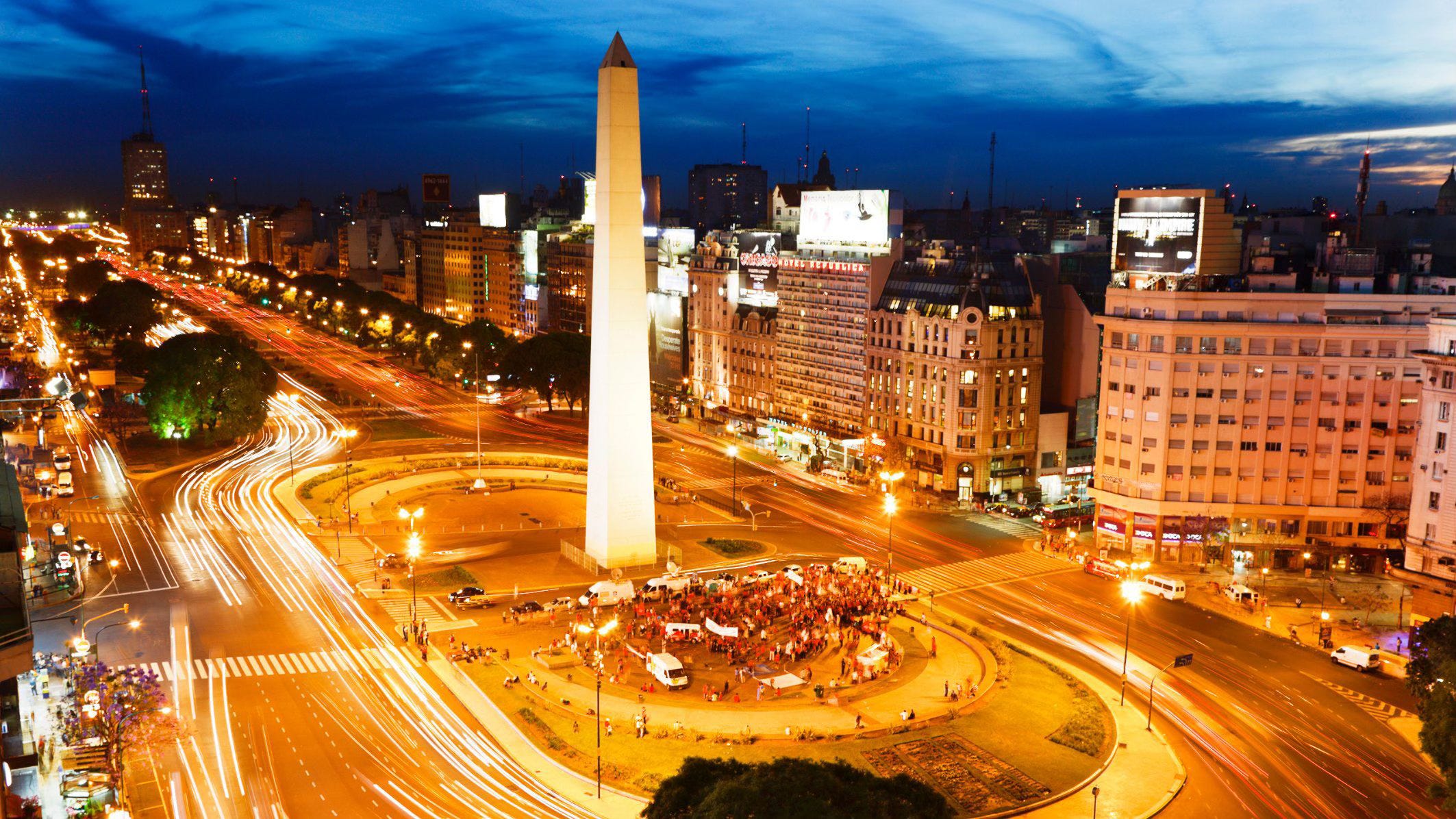
I’ll start by saying that it’s the spiritual center of the city, and the psycho-geographic one. (And yes, I’ll give you a prize if you can tell me the actual geographical center of the city).
Ever since this thing went up in 1936 people have been congregating there for one reason or another.
You can see it, right there, in the middle of everything, visible for miles along the two super-famous avenues which intersect it: 9 de Julio and Corrientes.
This towering slab has become so synonymous with this city that there’s a saying: “you’re more porteño than the obelisk,” which can be applied to a restaurant, a theater, or that guy in your neighborhood who sits on the sidewalk drinking mate and fixing the world from his folding chair. It’s the one object that represents everything Buenos Aires. Hey, why else would I have shot a video there to promote my podcast Tango Profiles?
You know that a building, a park, or a statue is the nerve center of a city when it’s the meeting point for massive gatherings.
The number of political protests which have taken place at the obelisco in the past 89 years is just about as great as the number of political protests in Buenos Aires. Sure, the national congress and the casa rosada (house of government) also see tons of protests, but many of those are marches which eventually go past the obelisk. It’s like a lightning rod for conflict.


Not all gatherings are in protest, of course. El obelisco has seen its fair share of concerts, happenings, and art projects. Ten years ago the artist Leandro Erlich made the top of the obelisk “disappear” and reappear on the steps of the museum of Latin American art as an act of democratizing the symbol. And sometimes the monument has been dressed up to celebrate the Olympics or bilateral relations with other countries, or to raise awareness: Famously in 2005 it was covered in a giant condom for World Aids Day.
And finally, since Argentina is the most passionate and fanatical fútbol country on earth, we have oversized soccer celebrations, and the obelisk is the place to have them. Some have gotten so ugly and complicated that they’ve led to confrontation and destruction of property (just ask the McDonald’s across from the obelisk), and others have been nothing short of euphoric, cathartic, and magical. In July 2024 my cousin Daniel visited during the Copa América, and when Argentina was crowned champion we joined the chaotic crowd down Corrientes avenue to the obelisk, where we got a dose of some top-notch Argentine soccer celebration, complete with fireworks, drummers, and a crowd prepared to stay out all night in the freezing winter weather.


Even more impressive, of course, was what happened in the summer of 2022 when Argentina won the World Cup.
The crowd on December 18th at the Buenos Aires Obelisk can only be described as a multitude, the biggest in history, bigger than the ones at Perón’s funeral in 1974, the start of Malvinas War in 1982, the return of democracy in 1983 or the social crisis of 2001.
Lionel Messi, having missed every chance at a World Cup victory in his 18 years on the national team, had finally made his (and our) dream come true. And after almost two years of pandemic and a handful more of recession and unbearable inflation, the people of Argentina had a big reason to celebrate.
It was absolute joy and catharsis as 4 million people filled the streets, making el obelisco look as if it were peeking out of an anthill.
And as you know from my post about the uniquely intense energy at the end of the year here, all of this was happening in the frenzied atmosphere which is unique to December in Argentina.
So now you know: the Buenos Aires Obelisk is much more than a symbol: it’s the center of it all, the starting and ending point of porteño identity. I’d love to hear your stories about obelisks, so go ahead a drop them in the comments.
I’m reading a few 📚books at the moment (let’s see how many I actually finish), but I’m going to spring another podcast on you because I found this one really interesting and moving.
Sara Bareilles is a singer-songwriter who made a big splash in the 2010’s. Although I’m only a little bit familiar with her music, I’ve heard her interviewed several times and find her to be very thoughtful.
In her interview on the New Yorker Radio Hour podcast, she has this to say: “Creation is a holy act. It’s sacred work…ministry to take care of the world with making art.” The quote comes after a discussion about the state of the music industry and advice for young artists.
I really like what she has to say and think her answers come from a calm, deep, and centered place…the kind of ideas the world needs to hear.
The whole episode is worth checking out (and by the way, the “Radio Hour” only lasts 30 minutes) so I’d encourage you to give it a listen, regardless of your artistic inclination.
Do you think creating art is a sacred act?
♫♪𝄞⨾𓍢ִ໋ of the week
La Música 55 - Diego Schissi Quinteto
I believe this is the first time I’ve mentioned Diego Schissi, one of the most original voices in contemporary tango. His 2016 album “Timba” plays with the theme of quiniela, a traditional lottery game here in which each number has a word associated with it. Ask an Argentine over 50, and they’ll know that 17 means “disgrace” and 22 means “crazy.” In this case, 55 is “music,” and Schissi dedicates his composition to one of the most musical people in tango history: the amazing Aníbal Troilo.
Mi ciudad y mi gente - Edmundo Rivero
I wanted to pick a tango to go along with the spirit of today’s topic. While it doesn’t mention the obelisk, it conveys a sense of total devotion to Buenos Aires and its people, as essential as the monument which represents them. The great Eladia Blázquez wrote the music and lyrics, which say: “I couldn’t live proudly beneath any sky other than yours.”
Este vacilón - La Familia Valera Miranda
You may not know about my relationship to Cuban music: I was active on the New York Cuban scene for about 10 years before deciding to focus exclusively on tango. I recently fell into a very, very pleasurable couple of weeks going through the recordings which used to be part of my daily soundtrack. This stuff is so good! La Familia Valera Miranda, a multi-generational family group from Santiago de Cuba is just incredible. Hearing them again makes me want to pick up a tres and play a few Cuban gigs.
Hi! I don't know if Parque Centenario is really the geographic center of BA, but it does feel like it is. One summer, when I was about finishing high school, I got together with a friend every day at Parque Centenario. We would choose arbitrarily one of the more than a dozen directions coming out of the crazy knot that is the essence of that park, and we would start walking, alternating left and right turns at every corner, to see where we would end up. I got to see a lot of the city that way, places I would never have had any need to go to.